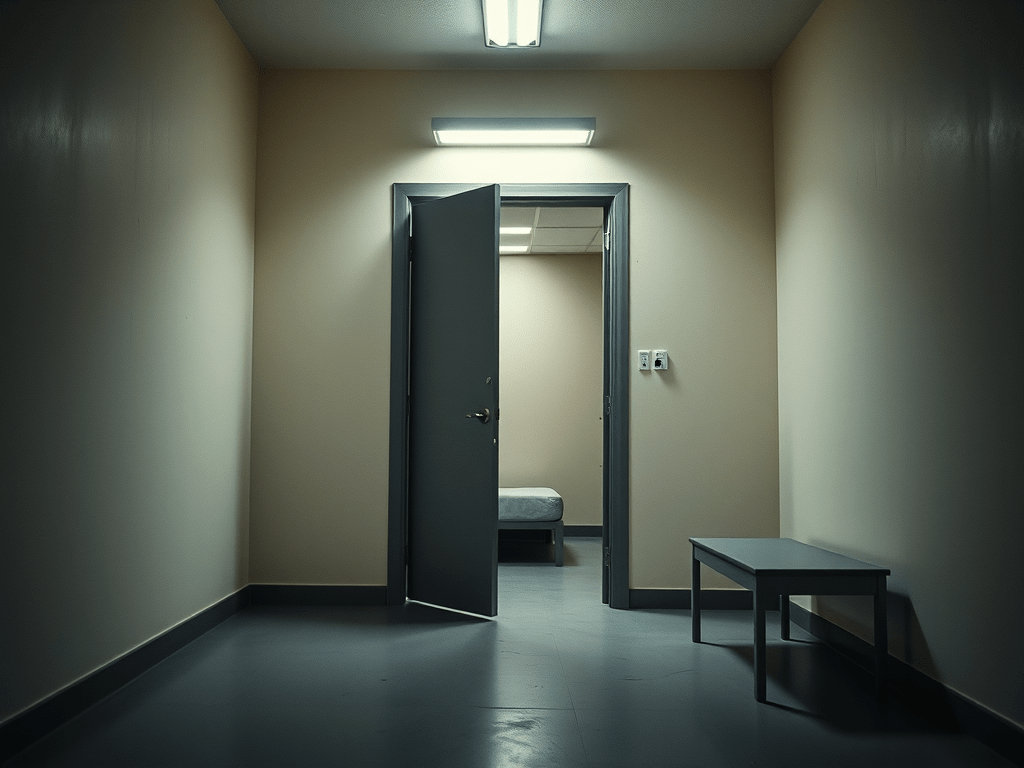
The walls were off-white but not on purpose, and not for any psychological reason either. They were white because they didn’t care. The room was just as insignificant: a single bed, and a toilet. The floor was a shade of gray that hadn’t been used in decades. The single florescent light that hung from the high ceiling was turned on each morning at 7:00 AM, and promptly turned off each night at 10:30 PM; leaving the small room in total darkness, a darkness so complete that it rivaled the deepest night.
The door was solid steel, for reasons unknown to its occupant. It could’ve been made of balsa wood because not a single person held in this or the hundreds of other rooms like it, dared open the door for fear of the endless possible consequences. Each morning, the doors would open automatically at 7:15 AM. The occupants had fifteen minutes to shower and prepare for breakfast, which was served at exactly 7:30 AM on the dot.
Once that door opens, the occupants have three minutes to exit the room and stand inside the yellow circle painted on the floor outside each room. The entire facility is a series of circles; yellow, red, black, and green circles—all indicating different circumstances and actions. A yellow circle indicated that the occupant must stand and wait for nearly any period of time. Once the yellow turns to green, the occupant is free to move to either the next circle or to the directed location. A green circle indicates that the occupant has been cleared to proceed. A red circle indicates that the occupant has violated a know policy and must remain in that circle until an investigation of the violation has completed. The circle will either turn green or black. A black circle is an indication of several situations. The first of which is that of a decision being made on the results of a policy violation. A policy violation does not always result in a black circle, however, committing an unforgivable act will result in an automatic black circle. The result of a black circle is automatic removal from the program.
The occupant of cell number 12 stands before the transom and waits for the door to open. The occupant knows the consequences of not being prepared. There were consequences to everything. If the occupant was not prepared once the door was opened, breakfast would not be provided.
With a hiss of depressurization, the locks disengaged and the steel door swung slowly outward. The occupant took a deep soul-cleansing breath and stepped lively into the yellow circle. Once all occupants were prepared and in their respective yellow circles, an alarm sounded and the yellows turned green, thus allowing the occupants to proceed to the showers. Shower time was considered free time. Occupants could use this time for self-reflection and cleanliness. They were not, however, allowed to look or speak to other occupants. This was considered an unforgivable act.
Upon the completion of the fifteen minutes of free time, the occupants were again placed in a yellow circle to prepare for the morning meal. All meal times were considered free. The occupants were allowed to engage in conversation. This conversation was monitored, of course. Any conversation that was deemed inappropriate was flagged for review and would be discussed during the morning therapy sessions. If the conversation violated policy, the occupant, or occupants were punished. Most punishments resulted in a revocation of any or all free time.
The occupant from cell number 12 sat alone with her tray of food, which usually was bacon, scrambled eggs, and a single slice of plain white bread. A small cup of coffee or juice was also provided. She ate in silence, finishing her try and lukewarm bitter black coffee—never looking around or engaging any other occupant in conversation. This was her third morning meal since she arrived at the facility. She spent this time trying to recall the events of the previous days. Her memory was more or less intact from a clinical sense. However, the events themselves were somewhat cluttered and cloudy.
She remembered her husband, Gavin, with his hazel eyes and dark long hair. She was shocked to learn that it was Gavin that put her here more or less. Her nightmares and constant anxiety didn’t make things any easier on him. She could see him there now, sitting on their deck in the back yard engrossed in some novel and holding a half full glass of his favorite lemonade. He loved his lemonade.
Jessica, her daughter was there with him; probably taking continuous jumps into the swimming pool. She had asked Gavin not to let the kids swim so early in the day, but what did it really matter? She would give anything to sit there with them and watch her cannonball into the deep end. She hated the idea of a swimming pool with two young children. Gavin insisted that it would bring the family together, which it certainly did, but it also made Elaine paranoid. She had read so many news stories about small children drowning in backyard pools that every summer her nerves were on edge. Two young children. Saying things like that in this place could get her into deep trouble. In the eyes of Echelon, she only had one child, her daughter, Jessica. Her son, Toby was taken from her nearly a week ago. Her husband and daughter are either part of the conspiracy, which is ridiculous, or she’s crazy and she never had a son.
Her first day at Echelon was spent in complete isolation and sedated; for her own good, of course. After which, she was subjected to hours of shock therapy, made to convince her that she never had a son. Yet no matter what they put her through—no matter how many times they told her she was wrong, she knew better. It was her second day at Echelon that gave her hope.
 Brian Kelly Irons
Leave a comment